

Why attempts to tank the CNDD-FDD system keep failing?
What if the CNDD-FDD’s greatest weapon isn’t power, repression or political machinery? In Burundi, it turns out that the road to political change may run through something dangerously unfashionable: "Empathy".


This is an opinion piece. That sounds obvious. An opinion piece contains opinions. Still, it is worth spending a moment elaborating on what we call an opinion, because opinions are not all born equal.
Ideas come and go with extraordinary speed. Rumour has it that a fertile brain can manufacture thousands of them in a day. Most disappear quietly. Others hang around. They meet other ideas, acquire supporting evidence, pick up a few prejudices along the road and eventually crystallize into opinions. Keep those opinions long enough and they begin shaping our worldview. Give them another few years and we start calling them convictions.
I have come to believe there are at least three kinds of opinion. The first is the recreational opinion. This is the sort that emerges after several very cold Amstels, when the solution to Burundi’s problems can appear remarkably simple. By morning, thankfully, much of this statesmanship evaporate. The opinion I am about to share did not come from there. Well, perhaps the first seed did. Let us stay honest..
The second kind is the considered opinion. It develops slowly through observation, conversations, contradictions, experience and the uncomfortable habit of questioning one’s own assumptions. You collect pieces over time. Some fit. Others force you to reconsider the entire picture.
Then there is the third category: the opinions you rarely say out loud. They may have enough logic behind them to keep bothering you, but they sit so far outside accepted thinking that sharing them comes with a risk. Not necessarily the risk of being proven wrong, that would be easy, but of watching the person across the table quietly reconsider their opinion of your mental stability.
This piece belongs somewhere between the second and third categories.
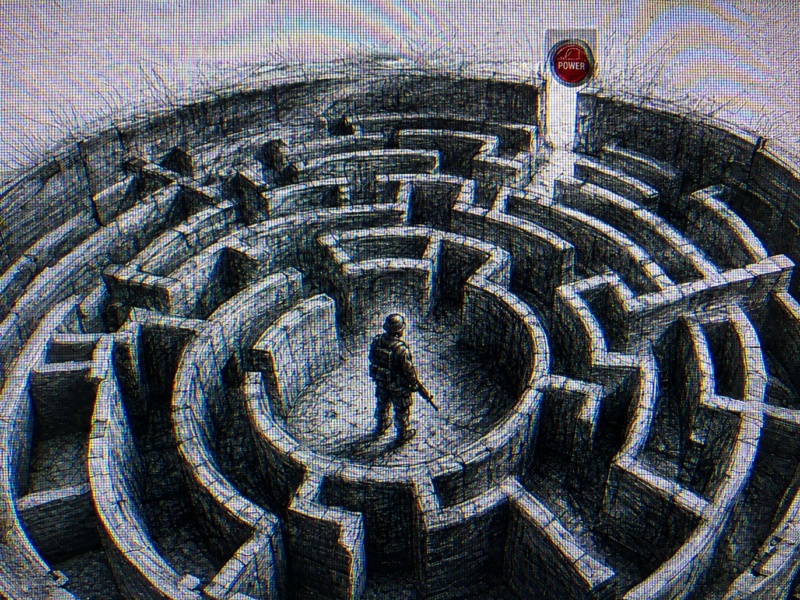
I am sharing it because some deeply established perceptions about Burundi’s politics deserve to be shaken. Perhaps the problem is that we have spent too much time studying who controls power and too little time studying the emotional architecture that allows power to reproduce itself.
My argument is fairly simple:
The durability of the CNDD-FDD system cannot be understood through political strategy alone. It also has to be understood through pain, memory and fear.
And if its opponents misunderstand those forces, they may keep attacking the system in ways that actually help preserve it.
First, what exactly is there to be “tanked”?
I am deliberately talking about the CNDD-FDD system, rather than reducing everything to individual leaders. People change. Presidents change. Ministers change. Generals retire. Governors disappear from television. Party officials rise spectacularly and sometimes discover gravity with equal speed.
Systems are different. A political system is the collection of institutions, loyalties, incentives, fears, historical narratives, economic relationships and habits that determine how power operates and reproduces itself. Removing one person does not necessarily remove that architecture.
So when people speak of “tanking” the system, one would assume that they mean defeating its ability to continuously reproduce political dominance. Why would anyone want to do that? The obvious answer is that they believe the system is bad.
That answer is incomplete. The desire to defeat a political system begins with something much older and simpler: the dynamics of power.
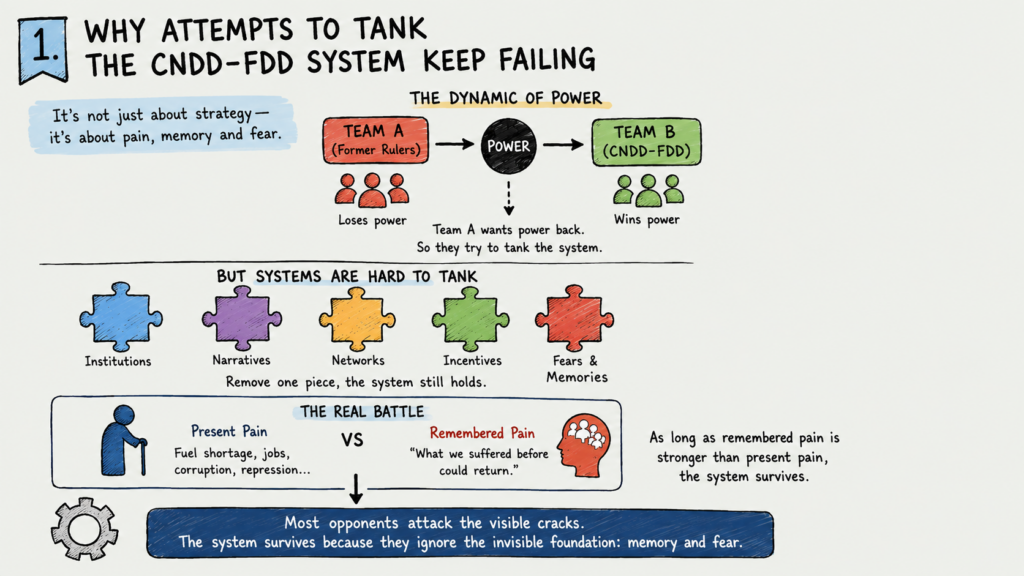
Imagine two political camps. Let us call them Team A and Team B. Team A has power. Eventually Team A loses it. Team B acquires it. Does Team A retire peacefully and take up gardening? Usually not. Power is pleasant. Winning is exhilarating. Influence opens doors. Being close to the state creates opportunities, protection, prestige and the comforting knowledge that when somebody says, “We need to speak to the authorities,” the authorities might actually answer your telephone call. Losing that position hurts.
Therefore, wanting to recover power does not automatically prove that the new system is evil. Political competition exists because people want power. Sometimes they want it for noble reasons. Sometimes for selfish reasons. Usually human beings are generous enough to contain both motivations simultaneously.
No political system is perfect because no collection of humans is perfect. Some systems are reasonably functional. Some are mediocre despite the good intentions of the people running them. Others become oppressive enough that citizens begin wondering whether incompetence has developed an ideology.
Whatever category one assigns to Burundi’s present system, its imperfections provide ammunition to those who want to replace it. Yet opposition to the system has repeatedly failed to fundamentally dislodge it.
Why?
This is where my uncomfortable opinion begins.
Team A and Team B
For the sake of the argument, let us simplify Burundi’s extremely complicated history. Simplification carries risks, especially in a country whose history has been written in blood and interpreted through competing memories. Still, we need a working model.
Call the political establishment that dominated much of the pre-CNDD-FDD state Team A. Call the political movement that emerged from rebellion and eventually consolidated power around the CNDD-FDD Team B.
These labels are deliberately crude. They should not be mistaken for ethnic labels, nor should every Burundian be forced into either box. Burundi’s political alliances have always been more complicated than two teams, and reducing individual citizens to ethnicity would reproduce precisely the kind of thinking this piece is trying to examine.
But history matters. Burundi’s post-independence decades included coups, political exclusion, massacres, civil war and enormous civilian suffering. Political and military power became entangled with ethnic identity, especially the long-standing dominance of Tutsi elites within the armed forces and state institutions and the exclusion and victimization experienced by large numbers of Hutu citizens.
Then came the civil war. The 1993 assassination of President Melchior Ndadaye, Burundi’s first democratically elected Hutu president, became one of the great ruptures in the country’s modern political history. Violence escalated, rebellions expanded and the country entered years of devastating conflict.
The Arusha peace negotiations attempted to construct a political answer to a historical problem that military victory had failed to resolve. The Arusha Peace and Reconciliation Agreement of 2000 created a framework for power sharing, institutional reform and ethnic balancing.
The CNDD-FDD was not initially a signatory to the Arusha agreement. It remained an armed movement before subsequent negotiations and ceasefire agreements opened the road toward its transformation into a political party.
Then came the elections of 2005. CNDD-FDD won. Pierre Nkurunziza became president. Burundi had entered a new political era. Most analyses begin from there by asking what CNDD-FDD did with power.
I want to ask a different question:
What emotional baggage arrived with it?
The political weight of pain
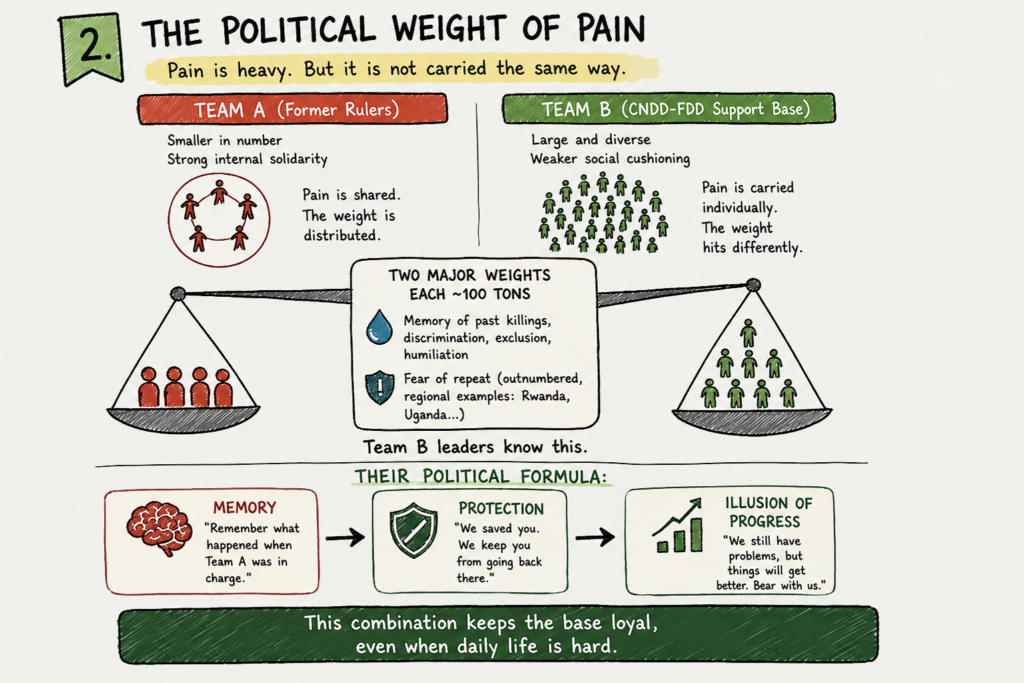
Imagine, purely as a thought experiment, that historical pain could be weighed. Put decades of killings, displacement, discrimination, humiliation, political exclusion, insecurity and inherited trauma on an enormous industrial scale.
For members of communities that experienced these things, call that weight 100 tonnes. The number is meaningless scientifically. Its purpose is simply to make something invisible easier to picture.
Now add another 100 tonnes: fear. Fear that history could return. Fear that political power could again be lost. Fear that yesterday’s hierarchy could reappear tomorrow. Fear generated by Burundi’s own history and amplified by the violent histories of neighbouring Rwanda, Uganda and the wider Great Lakes region.
We now have a political community carrying both memory and anticipation: the memory of what happened and the fear of what might happen again. This distinction matters enormously. Because political behaviour is rarely driven solely by present conditions.
People vote with memories. They tolerate with memories. They distrust with memories. Sometimes they endure extraordinary present-day hardship because the alternative has successfully been associated with something they fear even more. That is where I think many attempts to understand CNDD-FDD’s durability go wrong.
Pain is heavy, but people do not carry it equally
Here is the central proposition of my argument. Political groups develop different mechanisms for carrying collective hardship.
Historically, Team A’s smaller demographic and social networks encouraged strong mechanisms of solidarity and mutual support. When one member encountered difficulty, family, professional, economic or community networks could sometimes distribute the burden.
The weight remained real. But it was shared. Think of five people carrying a heavy table. The table still weighs the same, but nobody receives its full weight.
Team B developed under different historical conditions and across a much larger social base. Solidarity certainly exists, but not a the same level. Yet economic vulnerability and the sheer size and diversity of that constituency mean that hardship can remain intensely individual.
The citizen meets the price of beans alone. He meets the school fees alone. He meets the hospital bill alone. He meets the empty fuel station alone. And when electricity disappears halfway through something important, darkness does not accept political explanations. This produces a paradox.
The population that delivered political power to CNDD-FDD can simultaneously suffer under the system it helped create. From the outside, that appears politically fatal. Surely hardship should eventually produce revolt. Not necessarily. Because hardship can be interpreted through memory.
The system’s most powerful political resource may be memory
A governing system does not survive merely by telling people that life is good. Eventually citizens look inside their wallets. A more effective message is: Remember what life was before us.
That changes the comparison. The citizen is no longer being asked:
Is your life good today?
The question becomes:
However difficult today is, what could happen if the people you associate with yesterday returned?
That is an entirely different political calculation.
The system can then construct a narrative containing three elements:
Memory: You suffered before we came.
Protection: We prevented that old order from returning.
Deferred progress: The country still has problems because repairing the damage takes time. Bear with us.
The third part is crucial. Progress is always coming. The road is being repaired. The economy is turning a corner. Production will improve. Fuel will arrive.
Tomorrow is apparently an extremely productive day in Burundi. Almost everything works tomorrow. The difficulty is that tomorrow has a remarkable habit of remaining twenty-four hours away. Yet the narrative survives because material performance is only one component of political legitimacy.
The other is protection from remembered pain.
Pain can become a control mechanism
This is the uncomfortable part. If a political system derives legitimacy from protecting its supporters against a feared past, completely eliminating their suffering can create an unexpected political risk. People who become secure start demanding quality.
People who experience functioning institutions begin expecting them. People who acquire economic independence become harder to frighten. Once somebody has reliable electricity, clean streets, functioning hospitals, good schools, predictable administration and enough income to plan six months ahead, political expectations change.
Yesterday he was asking: “Will I survive?”
Today he asks: “Why exactly does this ministry require seven stamps?”
That second citizen is much more dangerous to a mediocre political system. Survival politics asks for protection.
Prosperity politics asks for performance. This is why mediocrity can become politically useful even when it was not deliberately designed that way. Citizens learn to tolerate dysfunction because dysfunction is compared with catastrophe rather than excellence.
A fuel shortage becomes annoying rather than politically transformative. Some supporters may reason: I do not own a car anyway. Meanwhile, the person with three vehicles is furious.
From the viewpoint of a struggling citizen, that anger can even appear comical.
“You have a Land Cruiser and you are complaining that there is no petrol? My brother, I am walking. Welcome to the opposition.”
The joke hides something serious. Economic hardship is politically powerful only when citizens interpret its cause and possible alternatives in roughly the same way.
In Burundi, they often do not.
Then came 2015
If there is one episode that illustrates my argument, it is the failed coup of May 2015.
The crisis began around President Pierre Nkurunziza’s controversial decision to seek another presidential term. Protests erupted. The constitutional and political dispute intensified. While Nkurunziza was outside the country attending a regional summit, a group of military officers announced that they had removed him. The coup failed.
Its consequences went far beyond the immediate military confrontation. For opponents of Nkurunziza, the episode represented desperation after political and institutional avenues appeared blocked. But politics is determined by perception as much as intention.
For parts of the CNDD-FDD constituency, the coup could be interpreted through a much older historical memory: they are coming back. Suddenly the argument was no longer only about presidential terms. It touched survival.
I witnessed something related to this firsthand while covering the campaign. After the failed coup, the atmosphere changed dramatically. Rally attendance surged. From what I observed on the ground, crowds became several times larger than before.
Whatever one thinks of the electoral environment surrounding 2015—and there are serious reasons to scrutinize it—the enthusiasm I witnessed among many CNDD-FDD supporters was real. That distinction matters.
It is comfortable to assume that every large authoritarian-party rally consists of people who were forced onto buses and handed a T-shirt. Sometimes that happens. Sometimes the person wearing the T-shirt actually believes what is printed on it.
After the coup attempt, many supporters were no longer processing the political crisis as an abstract constitutional dispute. The calculation became something closer to:
I would rather endure hardship under people I believe represent my historical security than risk returning to a political order I associate with historical pain.
Once politics reaches that psychological territory, ordinary opposition strategies become much less effective. You cannot defeat historical fear with a better campaign slogan.
The great strategic mistake
This brings us to the question in the title. Why have attempts to tank the CNDD-FDD system repeatedly failed? My answer is that too many of its opponents attack its visible weaknesses while reinforcing its invisible strength.
They attack economic failure. They attack shortages. They attack corruption. They attack institutional weakness. They attack repression. Many of those criticisms may be legitimate.But if the messenger is still associated in the minds of CNDD-FDD’s social base with an older threat, every aggressive move can activate the system’s strongest defence mechanism: memory.
The more frightened the constituency becomes, the more present suffering it may tolerate. That creates a vicious circle. The opposition says: “Look how badly you are suffering.” The system answers: “Look who wants to return.”
And the citizen, standing in a fuel queue for the fourth hour, has to decide which pain frightens him more. That is the battle. Not CNDD-FDD versus opposition. Present pain versus remembered pain. And remembered pain is a formidable opponent because memory does not need to be entirely accurate to be politically powerful.
It only needs to feel plausible.
So how do you actually crack such a system?
Here is where my argument becomes even more uncomfortable. The most powerful weapon against the CNDD-FDD system may be empathy.
That word sounds suspiciously soft in politics. People expect strategy to involve rallies, alliances, speeches, international pressure, electoral arithmetic and men in suits having urgent meetings in hotel conference rooms.
Empathy sounds like something printed on a motivational poster. Yet strategically, empathy can be ruthless. To defeat a political system built partly on historical fear, its opponents have to understand the pain that gives the system legitimacy.
Understanding does not mean agreeing with every interpretation of history. It does not require accepting collective guilt. It does not require pretending that one community suffered and another did not. Burundi’s history contains victims across communities. Empathy means recognizing that the political memory inside another person’s head is real enough to determine his behaviour.
You cannot argue someone out of a fear you refuse to understand.
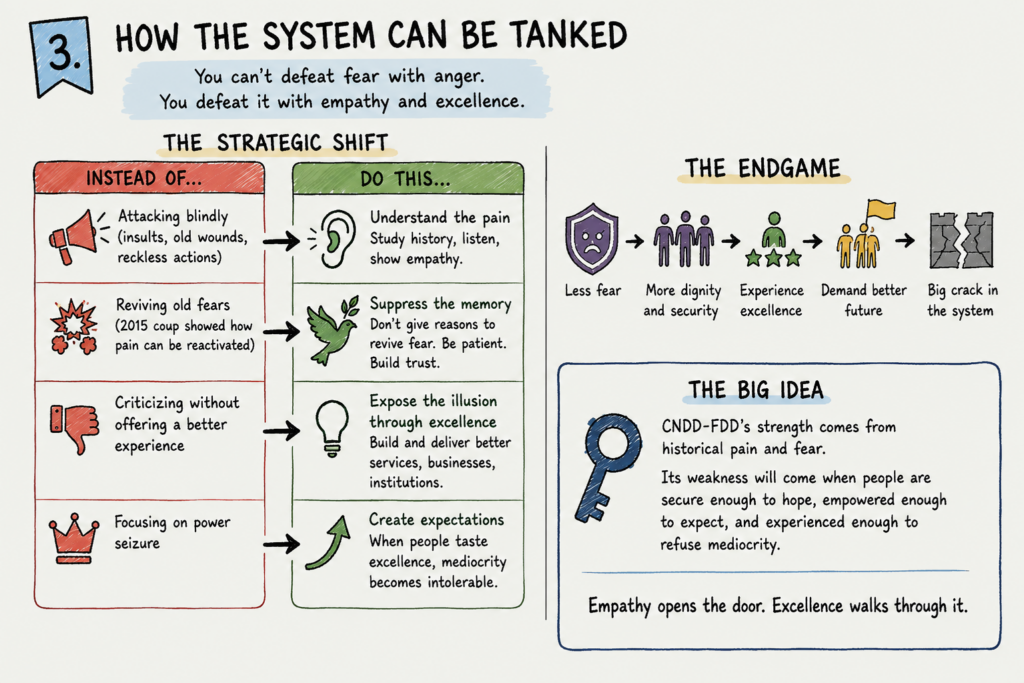
First: stop feeding the memory
Historical memory fades slowly. Political actors who want to challenge CNDD-FDD therefore need enormous discipline. Every statement matters. Every symbol matters. Every alliance matters. Every reckless act that resembles an older political threat can give the governing system years of additional psychological ammunition.
This is one reason I believe the 2015 coup attempt was such a strategic disaster. Whatever its architects intended, it gave historical fear a contemporary image. A memory that was slowly becoming history suddenly received breaking-news footage.
For younger generations who had not personally experienced earlier periods, the old story could now be transmitted with fresh evidence: “See? We told you.” That is how political memory reproduces itself.
Grandparents provide the story. Politicians provide the interpretation. Current events provide the illustration. The cycle begins again. Breaking that cycle requires patience bordering on boredom. No shortcuts. No heroic gestures that make excellent headlines and terrible strategy.
Second: expose the illusion through excellence
Criticism alone will not do it. Imagine telling a man every day that his house is badly built. Eventually he will ask: “Fine. Where is the house you built?” This is where Team A—or any serious alternative to CNDD-FDD—faces its biggest opportunity.
Build things. Invest in people. Create businesses. Support education. Develop competent institutions wherever influence is possible. Create professional networks that include people from communities historically associated with CNDD-FDD.
Demonstrate fairness. Reward merit. Let people experience excellence before asking them to vote for it. This matters because excellence is addictive. A person who has only known a three-hour administrative queue may accept it as normal. Then one day he enters an office where the process takes seven minutes.
Something terrible happens. He develops standards. Now the three-hour queue becomes unbearable. That is how mediocrity loses power. Not when somebody explains that mediocrity is bad. When people experience something better.
Give Team B something dangerous: expectations
If CNDD-FDD’s historical strength comes partly from telling its constituency, “We protected you,” then its greatest vulnerability may emerge when that constituency begins asking: “Protected us for what?” Protection is supposed to create the conditions for life. Security should eventually produce prosperity.
Political inclusion should eventually produce functioning institutions. Representation should eventually produce opportunity. At some point, historical liberation has to submit itself to contemporary performance.
You cannot govern forever on a receipt from history. A generation born after the civil war will increasingly judge the state according to what exists in front of them.
Does the electricity work? Can I find a job? Can I start a business without knowing somebody? Can my children receive a good education? Can I obtain public services without begging? Can I criticize an official without calculating whether my family should start worrying?
Can I buy fuel without developing a personal relationship with a jerrycan? These questions are politically transformative because they move citizens from gratitude toward expectation. And expectations are dangerous to any system accustomed to being evaluated against the past.
The opposition’s job is therefore stranger than it appears
The instinct is to make CNDD-FDD supporters angrier. I think the deeper strategy is to make them less afraid. Make them feel that political change would not erase their dignity. Make them believe that losing an election would not mean losing their country. Make them confident that institutions could protect them regardless of who occupies the presidency.
Make their children economically secure enough that politics stops feeling like a life-insurance policy.
Then introduce them to excellence. Once citizens discover that security and competence can coexist, the political equation changes dramatically.
The old choice, us with all our problems, or them with all your historical fears, loses its force.
A third possibility appears: security without mediocrity.
That is the crack.
Perhaps we have been studying the wrong battlefield
Burundi’s political future will obviously depend on institutions, elections, economic conditions, regional politics, security forces, party organization and leadership. But underneath all of those sits something harder to measure. Memory. Pain. Fear. Belonging.
The CNDD-FDD did not emerge from a vacuum. It emerged from a particular history, and the system built around it continues to draw political energy from that history. Anyone trying to defeat that system without understanding the emotional world of the people who sustain it is effectively playing chess while refusing to look at half the board.
This is why empathy matters. Not sentimental empathy. Strategic empathy. The ability to look at someone whose politics you dislike and ask:
What happened to this person, or what does this person believe happened to people like him—that makes the present arrangement feel safer than the alternative?
Answer that question seriously and Burundi’s political landscape begins to look different. Then do something even harder. Give that person fewer reasons to fear you. Help reduce the weight he carries.
Create institutions and opportunities that make historical identity less important to economic survival. Show him what competent governance feels like. Allow prosperity to replace political dependency. Let excellence create expectations.
Because a citizen who is terrified can tolerate almost anything from his protector. A citizen who feels secure begins asking questions. A citizen who has tasted excellence becomes particularly troublesome. He wants the electricity to stay on. He wants fuel at the station. He wants competent schools. He wants officials who answer questions. He wants public money accounted for. And, God help every politician involved, he may eventually start expecting all of these things at the same time.
That is when a political system truly has a problem.
Perhaps the repeated failure to dislodge CNDD-FDD has less to do with the strength of the fortress than with the strategy of those attacking it. They keep attacking the walls. I suspect the real entrance is somewhere else. It runs through memory. Through dignity. Through security. Through the slow removal of fear.
And finally, through something Burundi’s political class has rarely treated as a revolutionary weapon:
“Giving people enough experience of excellence that they refuse to settle for less.“
Profound and excellent analysis of the causes and the current political situation in Burundi
I am left with my thirsrt when i read the proposed solutions .How one create the condition of excellence when the system can,t tolerate any initiative that is not delivered within the letter and spirit of rhe CN-DD system
You really missed the point from the beginning. This is an awful reflection on the Burundian politics. Look, how do you mention “memory” and you put it between these two teams A and B? You are talking about the memory of which past? In the past, the citizen had only one problem: security. Who said that this Team A is a threat today? Do you know the role of the state? Is it the opposition which is supposed to provide security, excellence? You have mixed up a lot of things. If a system works under fear of any kind, it becomes self-deafiting. It lacks trust in itself to counteract any enemy. In short, your analysis missed the point. The system of Team B should deliver its best knowing that not doing so, it is worsening the situation left by Team A. Today, the citizen wishes to go back to the time of Team A, which is a deplorable thing.