BUJA City Plaza: Is this an investment opportunity or a moving target?
Behind the glossy launch of BUJA City Plaza's second fundraising round lies a project whose timeline, financing and governance have shifted repeatedly

“Trust, but verify,” goes the old saying. When it comes to investing, most people would probably reverse the order: verify first, then trust.
This week, the promoters of BUJA City Plaza unveiled the second phase of fundraising for the reconstruction of Bujumbura’s former central market. The headline was designed to inspire confidence. Construction has started. A new fundraising round is open. The value of a share has increased from 103,000 BIF to 111,000 BIF, and investors from the first round are promised an 8% bonus.
On paper, it sounds like momentum.
But once you look beyond the ceremony and compare today’s announcements with yesterday’s promises, a rather uncomfortable question emerges:
Has the project become more valuable, or have the promises simply become more expensive?
The story of the former central market is now entering its thirteenth year.
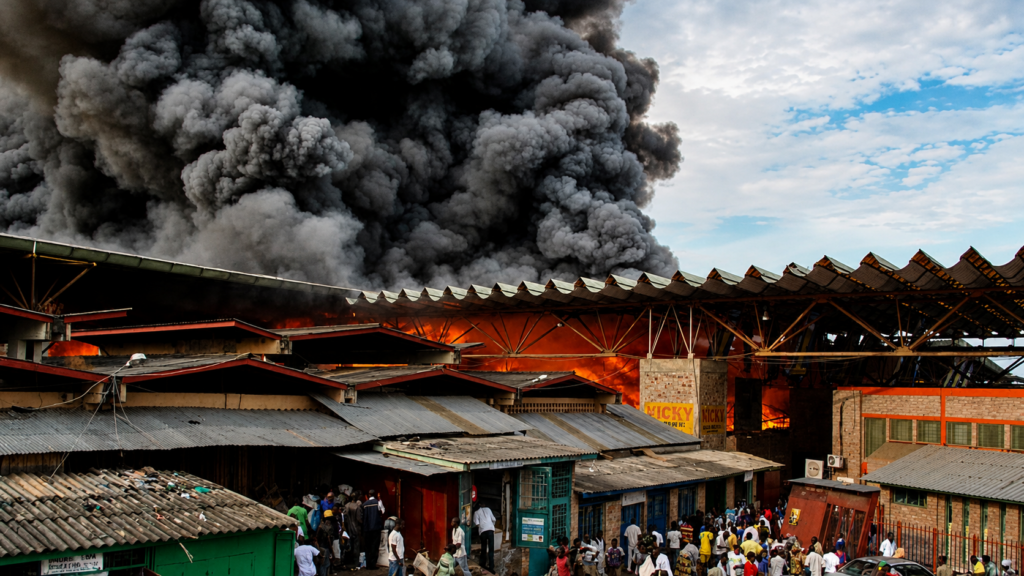
Since the devastating fire of 2013, nearly 5,000 traders have watched the economic heart of Bujumbura remain little more than an empty fenced-off plot. Governments have promised reconstruction. Investors have expressed interest. Ceremonies have been held. Yet the market itself has remained stubbornly absent.
When Ubaka Nation Group was introduced as the company that would finally deliver the long-awaited project, expectations were high.
In July 2024, its founder, Fablice Manirakiza, confidently told President Évariste Ndayishimiye that the project could be financed without a single franc from the State, relying solely on contributions from Burundians and the diaspora. The ambition was extraordinary: five commercial complexes, a 30-storey tower and a modern shopping district financed by ordinary investors.
Today, that promise appears to have evolved considerably.
Instead of a privately financed development, the government has since announced that the project will proceed under a Public-Private Partnership (PPP), a significant shift from the original vision.
Changing strategy is not necessarily a problem. Circumstances change. Projects evolve.
But investors usually appreciate being told why.
When yesterday’s promise quietly disappears
Large infrastructure projects often change course. What matters is transparency. The original message was simple: We don’t need government money. Now the project involves government participation.
That raises perfectly reasonable questions. What changed? Did the original financing plan fall short? Was the fundraising insufficient?
Did the financial studies reveal higher costs?
Or was the original promise simply too optimistic?
None of those questions are answered in the latest announcement.
Perhaps the most intriguing part of the new fundraising campaign is not the increase in the share price.
It is the explanation for the 8% premium awarded to first-round investors.
According to the organisers, that premium will be financed by subscriptions from investors entering during the second fundraising round.
That deserves a second reading. In most investments, returns come from profits generated by the business itself.
Shopping centres earn rent. Factories sell products. Hotels rent rooms. The money flows from economic activity. Here, however, the first reward for early investors comes before the building has generated any income.
Instead, it is funded by money coming from new investors. Now, this may well be entirely legal if it is clearly disclosed in the approved prospectus and structured as an early-bird incentive. Capital markets allow many different fundraising mechanisms.
But from an investor’s perspective, the obvious question remains:
If returns begin with new subscriptions rather than operating profits, what exactly is driving the investment value today?
A share price that rises faster than the building
One week after construction officially resumed, the value of each share increased by almost 8%. Markets rise all the time. Property values rise. Companies become more valuable.
But they usually do so because something measurable has changed. The latest announcement does not explain what independent valuation justifies the higher share price.
Has the land been revalued? Has the project secured major tenants? Has financing materially improved? Or is the higher price simply part of the fundraising strategy?
Without an updated valuation, investors are essentially being asked to accept that the project is worth more because… well, because it is. Perhaps the most remarkable construction achievement so far has been… cleaning.
Earlier this year, reports indicated that around two billion Burundian francs had been spent on clearing and cleaning the site, despite little visible reconstruction afterwards.
Two billion francs is a serious amount of money.
Naturally, people began asking what exactly had been done.
If cleaning an old market costs billions, one cannot help wondering whether the bulldozers came with complimentary gold-plated brooms.
Humour aside, the question is serious. Were these costs independently audited? Were contracts competitively awarded? Can shareholders examine the expenditure?
Those answers matter because every franc spent before construction is a franc that no longer builds the project.
Procurement: who is building this?
Oddly, despite construction now being underway, very little has been made public about procurement.
Who won the construction contract? Was there a competitive selection? Who evaluated technical bids? What experience does the contractor have delivering projects of this scale?
Civil society organisations, including OLUCOME, have repeatedly argued that a project involving such an important public asset should be supported by credible technical studies, transparent procurement and internationally recognised governance standards rather than optimism alone.
These are not bureaucratic details. They are the foundations of investor confidence.
Another interesting evolution concerns the project’s timetable.
Earlier public statements suggested investors might recover their investment within five to eight years, depending on commercial performance.
Today’s announcement speaks instead of a 24-year operating period before the complex is transferred back to the State.
Neither approach is inherently unreasonable. Commercial concessions often last decades.
But changing such fundamental assumptions naturally prompts investors to ask what other assumptions may also have changed.
Perhaps the greatest challenge facing BUJA City Plaza today is not engineering.
It is credibility. The former central market has become a symbol of postponed promises.
Every new announcement raises hopes. Every delay makes the next announcement harder to believe. Many citizens who initially considered investing now openly admit they are waiting to see actual construction before committing their savings.
That hesitation is understandable. Investors are not buying speeches. They are buying future cash flows.
Questions that deserve answers
None of this proves fraud. None of it proves mismanagement. And none of it means BUJA City Plaza cannot eventually become a successful development.
But before thousands of Burundians are invited to invest again, several questions deserve clear, public answers:
Why did a project initially presented as privately financed later require a Public-Private Partnership?
What independent valuation justifies the increase in the share price?
Why is an 8% reward for first-round investors financed by second-round subscriptions rather than project revenues?
Who was awarded the construction contracts, under what procurement process, and based on which technical qualifications?
How were the reported site-clearing costs calculated and independently verified?
Where are the feasibility studies, cash-flow projections, governance structures and audited financial statements that investors can examine?
The reconstruction of Bujumbura’s central market is about restoring one of the country’s most important commercial hubs, reviving the livelihoods of thousands of traders and demonstrating that large public projects can be managed with transparency and professionalism.
After thirteen years of waiting, Burundians deserve more than another launch ceremony. They deserve clear contracts instead of changing narratives, audited figures instead of assumptions, and cranes that keep moving after the cameras leave.
In capital markets, confidence is built brick by brick, much like the buildings themselves. And in the case of BUJA City Plaza, investors may find that the strongest foundation is not concrete, but transparency.