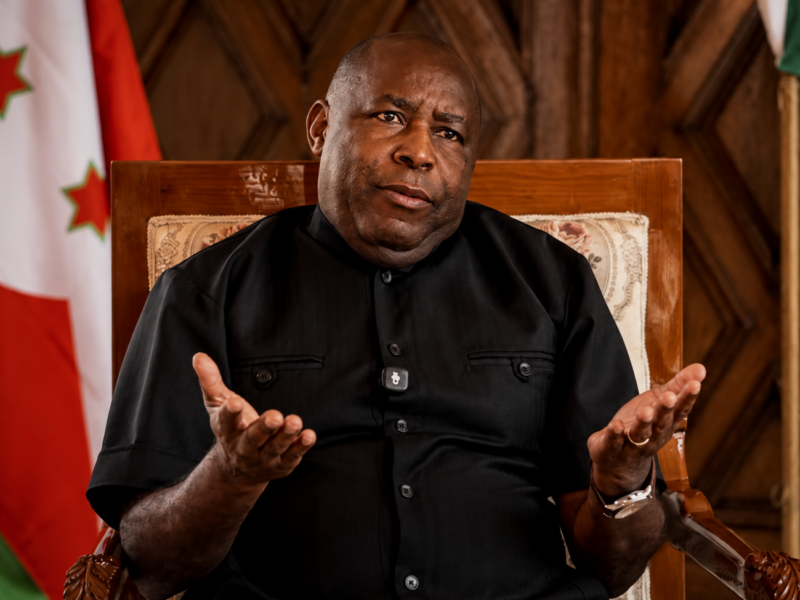
Why Is former AU official Amb. Frédéric Gateretse-Ngoga embarrassingly shopping for media reputation after his AU-PAP dismissal for gross misconduct?
In a region where ethnicity, exile and embassy queues are already loaded weapons, turning other people’s panic into a personal “watch this space” is not peacebuilding, it is reputation shopping with the receipt still showing.


In East African politics, the difference between a resignation and a firing is often treated as a matter of taste. One sounds like principle. The other sounds like paperwork. Former AU official Amb. Frédéric Gateretse-Ngoga has spent the last week trying to make the resignation version stick. The institution he left has, according to several regional outlets, insisted on the dismissal for gross misconduct. If branding were a sport, this would be the bit where the athlete announces a graceful retirement while security is still holding the door.
On 8–9 September 2026, Ngoga posted that after 17 years at the African Union Commission he had decided to resign. The first version was short and theatrical: a rendezvous with history, “shall we meet again.” Then the post vanished, the diplomatic equivalent of sending the wedding invitation and uninviting the groom before dessert.
Then came a longer, more polished statement: two decades of “committed and competent service,” wings spreading to “another perch,” Burundi as a regional test of prevention rather than aftermath, a warning against rumour mills, and the closing line that has already become a slogan: “Watch this space.”
Watching the space is exactly what journalists did. Several Kenyan and regional newsrooms reported that the AU Commission said he did not resign. He was summarily dismissed for gross misconduct. “Watch this space” is a bold closer when the space in question appears to be a human-resources file.
A circulating letter has not been independently authenticated by every outlet, but the institutional contradiction is now public: one man selling an elegant exit, one organisation describing a disciplinary one.
That is not a small discrepancy. It is the first rule of political branding. If you cannot control the verb, resigned versus dismissed, you try to control the soundtrack. Preferably with strings, a continent, and a perch.
From back-office diplomat to public brand
Ngoga was not a household name in Bujumbura street politics. He was a career AU figure: conflict prevention and early warning, borders, regional security mechanisms, and earlier work around AMISOM.
The kind of official who knows how communiqués are drafted and how little they usually move anyone. For years the job is to make language so careful that nothing happens. Then, suddenly, the language is supposed to make history keep an appointment.
The turn toward public relevance started months earlier, not in Nairobi queues but in a single sentence about ethnicity.
In late May 2026 he wrote that discrimination against Tutsi communities in Burundi still existed, that acknowledging it mattered for justice and cohesion, and that he expected insults. He got them. In Great Lakes politics, announcing that you expect insults is like announcing you expect rain in April. You will not be disappointed, and you will look prepared.
Serving Burundian officials pushed back hard, calling the comments divisive and arguing that a sitting AU official should not inflame the most combustible file in the country. The New Times and other regional platforms amplified both the post and the collision.
That was not a slip. In the Great Lakes, ethnicity is not a seminar topic. It is the language of power, memory, quotas, armies, and exile. The 2000 Arusha architecture was built precisely because that language had already cost hundreds of thousands of lives. Anyone who has spent 17 years in “peace and security” knows that lighting that match in public is not accidental. It is a positioning choice. You do not “accidentally” lean on the one switch marked Do Not Touch Unless You Want a Panel.
A peace-builder can argue, in good faith, that silence is complicity. A political entrepreneur can notice that the same silence is also a vacuum, and that the person who names the taboo first can claim the chair of “honest broker” later. Both readings are now in circulation. Only one of them needs an audience. The other can live quietly on a per diem.
The Kenya episode: real hardship, useful timing
Then came September’s crackdown on unlicensed small traders in Kenya. Burundians queued at their embassy for emergency papers. Families were frightened. That part is not spin. BBC and Kenyan outlets documented the scramble. Kenya later clarified that documented foreigners could stay and offered a 90-day window to regularise. The human mess was real.
Ngoga posted a pointed question: why Burundians specifically, when other nationalities also trade in Kenya? Then he welcomed the grace period. Then, within a day, the resignation theatre. Then the deletion. Then the longer manifesto that folds Burundian displacement, Kenyan analysis, early warning, and his own departure into one moral package. It is an impressive origami. You start with other people’s panic and end with your own tagline.
This is the dichotomy. Fellow citizens being harassed or panicked is a political fact. Using that fact, within 24 hours, as the launch pad for a personal origin story is a strategy. You can care about the traders and still notice the choreography. The two are not mutually exclusive. They are also not the same thing. Solidarity is allowed to arrive without a press kit.
Some coverage framed the AU action as punishment for criticising Kenya. Other coverage treated that as the convenient public version of a private disciplinary file. DW Africa’s Facebook post circulated the resignation-first framing that many outlets initially ran. Kenyans.co.ke and The Eastleigh Voice later reported the Commission’s rebuttal: not a resignation, a dismissal for gross misconduct. Readers can hold both the humanitarian complaint and the HR dispute without collapsing them into one noble martyrdom. Martyrdom, like chicken, is better when it is not processed twice.
How an unknown official engineers relevance
The method is familiar across the region. First, pick a sacred wound. In Burundi that wound is ethnic hierarchy after Arusha, who still sits in the presidency, intelligence, army, schools. Raise it loudly enough that the presidency and the party have to answer. You are no longer a technician. You are a protagonist. Congratulations: the meeting has been upgraded from “any other business” to “the only business.”
Second, survive the condemnation. Insults become proof you told the truth. Official anger becomes proof the system is brittle. The New Times even ran a piece titled around his line “I expect insults.” That is not failure. That is distribution. If the government replies, you have traction. If it does not reply, you have courage. Either way, the content calendar is fed.
Third, take the show on the road: interviews, podcasts, Kenya-facing media, the tone of a man who has left the building and can finally speak. “Freedom is sweet. I will be speaking soon.” Cryptic posts are not confusion. They are a drip campaign. Deleting a tweet is not clumsiness if the screenshot lives forever. It is a way to plant two stories at once: I walked; they pushed. Schrödinger’s diplomat: resigned and dismissed until the next podcast.
Fourth, write the grand statement that turns a personnel fight into a continental doctrine. Prevention not aftermath. Regional ownership. “My country. My region. My continent.” It is fluent AU-speak. It is also a CV. If you squint, the misconduct hearing becomes a keynote.
None of this proves a conspiracy. It does prove a craft. Ambition is legal. Opacity is optional. Mystery is only elegant when it is not doing HR’s job for it.
Power, minorities, and the jokes everyone already knows
Great Lakes politics runs on two parallel conversations. One is official: sovereignty, EAC, AU mechanisms, non-interference. The other is the bar-stool version: who really backs whom, which capital hosts which exile, which “minority question” is a human-rights file and which is a ladder. The first conversation uses “architecture.” The second uses first names and a look.
Ngoga’s critics in Bujumbura hear a Tutsi diplomat internationalising an ethnic grievance to reopen a settlement they consider closed. His sympathisers hear a man saying out loud what civil-society reports have said for years about quotas that exist on paper and thin out in practice. Independent Burundian and UN-adjacent reporting has long documented both Hutu majoritarian capture of the state and the cynical use of ethnicity by every side.
That history does not need a cartoon “Hima empire” to be ugly. The cartoon exists because the real pattern of cross-border elite networks, refugee politics, and the recycling of 1990s fears, is close enough to parody itself. Treat the parody as parody. Treat the power struggle as real. The region has enough actual tragedy without commissioning a streaming series about cattle and destinies.
Commentators have also linked his media circuit to broader opposition and regional sponsorship talk, including gossip around Kampala. Gossip is not evidence. Ngoga himself wrote that speculation is not intelligence. Fair.
The same standard applies to his own story. A deleted resignation is not a doctrine of prevention. A long thread about Burundi’s displacement is not a certified reason for leaving an AU contract. “Watch this space” is an invitation, not a disclosure. If speculation is not intelligence, a disappearing tweet is not a white paper.
Honesty is the cheap part of change
Wanting a political career is ordinary. Plenty of serious people leave multilateral jobs because the institution is slow, captured, or allergic to naming causes. That argument can be true in general and still be a costume in a particular case. The AU has many sins. Not all of them are available as personal branding.
The embarrassing part is not ambition. It is the refusal to let the record be simple. If you were fired, say you were fired and fight the charge. If you resigned on principle, leave the letter up. If the Kenya trader crisis moved you, separate the families in the embassy queue from the personal rebrand. Mixing them is what makes the shopping visible: the same week as a disputed exit, a search for headlines that recode misconduct as prophecy. That is not early warning. That is product launch.
DW and AU-facing reporting that first circulated a resignation narrative, and later Kenyan reports of an official dismissal, are why the dichotomy will not die. PR can buy a friendly headline. It cannot merge two verbs. You can hire the megaphone. You cannot hire the dictionary.
Burundians in Kenya deserved consular urgency, not a subplot. Burundi’s ethnic bargain deserves inquiry that is boring, documented, and not timed to a personal launch. The AU deserves staff who know the difference between early warning and a personal teaser trailer.
Office changes. Mission continues. That line works in a farewell. It works less well as a cover letter written over a deletion button. Watch the space, by all means. Watch the footnotes harder. And if history really has a rendez-vous, it usually prefers people who leave the invitation online.