Sergey Lavrov in Burundi as Russia deepens its diplomatic offensive in Africa
Three years after making history as the first Russian foreign minister to visit Burundi, Sergey Lavrov is back in Bujumbura, with trade, security and Africa’s shifting geopolitical alliances on the agenda.

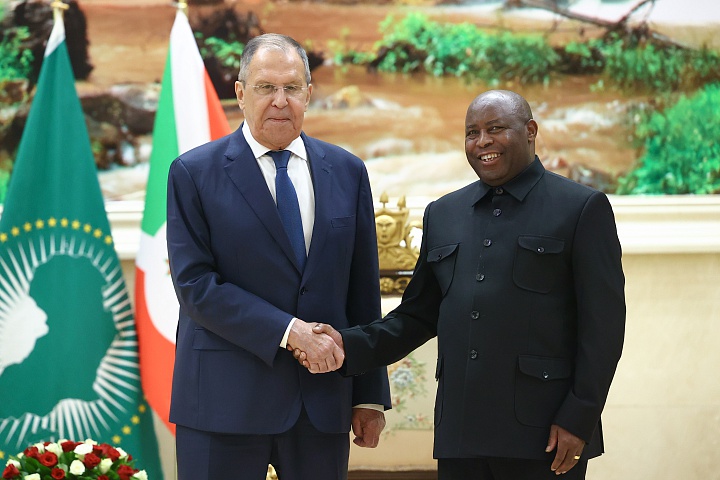
The Russian foreign minister concluded a four-country African tour in Bujumbura, where he was received by President Évariste Ndayishimiye. The visit comes as Moscow seeks to consolidate its influence across the continent ahead of the third Russia-Africa Summit.
Sergey Lavrov is continuing Russia’s methodical diplomatic push across Africa. The veteran Russian foreign minister arrived in Burundi on July 10, the final stop of a tour that had already taken him to Ethiopia, Niger and Mozambique.
Upon landing at Melchior Ndadaye International Airport in Bujumbura, Lavrov was welcomed by his Burundian counterpart, Édouard Bizimana, a diplomat intimately familiar with Moscow. Before his appointment as foreign minister in 2025, Bizimana had served as Burundi’s ambassador to the Russian Federation from 2016.
This was Lavrov’s second official visit to Burundi. His first, on May 30, 2023, marked a historic milestone as the first visit by a Russian foreign minister to the East African nation.
During his latest visit, Lavrov was received by President Évariste Ndayishimiye before holding talks with Foreign Minister Édouard Bizimana. Discussions focused on strengthening bilateral relations in diplomacy, trade, economic development and humanitarian cooperation, as well as international and regional security.
Beyond the customary language of diplomatic communiqués, Moscow and Bujumbura have increasingly displayed a convergence of views on the international order. Both governments advocate what they describe as a more “just polycentric world order” and have pledged closer coordination at the United Nations and other multilateral forums.
That alignment carries particular significance at a time when Burundi holds the rotating presidency of the African Union. Lavrov’s visit therefore extends beyond bilateral Russian-Burundian relations and forms part of Moscow’s broader effort to consolidate its diplomatic influence across the continent.
The Russia-Africa summit in Moscow
One of the central issues discussed in Bujumbura was the third Russia-Africa Summit, scheduled to take place in Moscow in October 2026. President Ndayishimiye was formally invited to attend and co-chair the gathering in his capacity as the African Union’s current chair.
For Russia, which has faced sweeping Western sanctions and deepening isolation from Europe and the United States since its full-scale invasion of Ukraine in 2022, Africa has become an increasingly important diplomatic arena. Moscow has cultivated political, economic and security partnerships across the continent while presenting itself as a champion of a multipolar international order free from Western dominance.
Lavrov’s African tour illustrates that strategy. Before arriving in Bujumbura, the Russian foreign minister visited Ethiopia, Niger and Mozambique. In Niger, he also participated in ministerial consultations between Russia and the Alliance of Sahel States, comprising Mali, Burkina Faso and Niger — three military-led governments that have broken sharply with their former Western partners.
Security in the great lakes region
The talks in Bujumbura also addressed conflicts and security challenges across Africa, with particular attention paid to the Great Lakes region.
Burundi occupies a strategic position in this volatile part of the continent, bordering the Democratic Republic of Congo, Rwanda and Tanzania. Regional tensions, particularly the continuing conflict in eastern Congo, have given Bujumbura greater diplomatic and security relevance at a time when relations between several of the region’s capitals remain fragile.
According to official statements, the discussions took place in a “warm and trusting atmosphere.” The familiar diplomatic formulation nevertheless reflects a broader reality: three years after Lavrov’s historic first visit to Burundi, Moscow and Bujumbura appear determined to place their rapprochement on a more lasting footing.
For the Kremlin, the Burundian stop also brought to a close a tour emblematic of Russia’s ambitions in Africa. From the Horn of Africa to the Sahel, and from the Indian Ocean to the Great Lakes, Moscow continues to expand its diplomatic presence on a continent that has become one of the central arenas in the struggle to shape an emerging global order.